.png)
31,495 AI Prompts Later: What Actually Gets a Local Business Cited

We tracked 6,299 business campaigns across ChatGPT, Gemini, Perplexity, and Claude. Here's what the visible businesses had in common, backed up by what outside research is finding too.

More people are skipping the search results page and just asking an AI assistant directly: "who's a good plumber near me," "recommend a dentist in [city]." The businesses that get named in that answer get the call. The rest don't exist as far as that customer is concerned.
To find out what separates the two groups, we tracked 6,299 local business campaigns, each checked against five different local-intent prompts, for a total of 31,495 prompts, run across four AI engines: ChatGPT, Gemini, Perplexity, and Claude.
The same handful of factors kept showing up, no matter which engine we looked at.
At a Glance:

Here's each factor in more detail, along with outside research that points in the same direction.
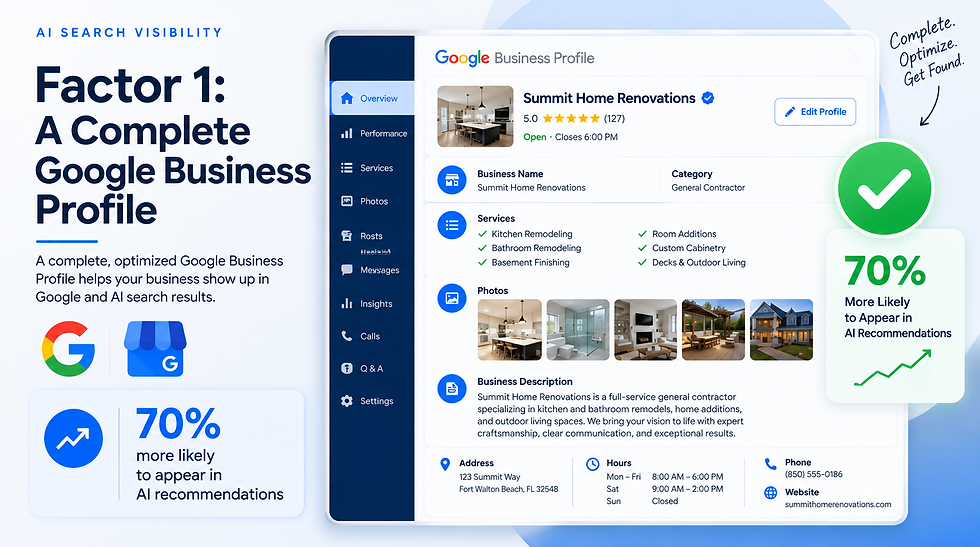
A complete Google Business Profile. Category, services, photos, and description all filled in properly. This came up more consistently than any other single factor in our data. It lines up with outside research too: one benchmark found businesses with a complete, active profile are roughly 70% more likely to appear in AI-generated local recommendations, and a separate analysis of over 858,000 small business websites found sites with synced business information were noticeably more visible to AI crawlers than sites without it

Reviews. Not just having them, but having a steady flow of them and responding to them. The same largescale website analysis found businesses with customer reviews present were meaningfully more visible to AI crawlers than those without. Separate local ranking research found review signals now carry roughly 20% of local ranking weight, up from 16% two years earlier, one of the biggest single increases of any factor tracked. Responding to reviews with specific, helpful detail (not just a generic thank you) also came up repeatedly as a trust signal AI systems seem to pick up on.

Hours of operation, kept accurate. This sounds minor but isn't. Some of the newer AI-powered local search features answer questions like "which plumber near me offers emergency service after 10pm" by reading hours directly off a business's profile in real time. Wrong or missing hours don't just annoy customers who show up at a closed door, they can mean an AI system skips the business entirely for any time-sensitive query

A verified Google Maps listing. Not just a claimed profile sitting there, but one tied to a confirmed Maps entity. It gives AI systems a canonical record to pull from instead of guessing. This tracks with how AI-powered local search tools are built now, answering conversational local questions by reading business profile and Maps data directly. Local ranking research puts these profile signals at roughly 36% of local pack ranking weight overall, up from 33% two years earlier.

Matching business details everywhere. Same name, same address, same phone number on the website, on your business profile, and across directories. Even small mismatches seem to make AI systems hesitate and skip the citation entirely. AI systems appear to build confidence in a business from repeated, consistent signals: when the name, category, and description line up across the website, profile, and major directories, AI tools can identify and recommend the business more reliably

On-page optimization: titles and schema markup. Page titles that clearly state the service and location, plus schema markup (LocalBusiness, FAQ, and service schema in particular) that spells out who you are and what you do in a format machines can read directly, both matter. In one large-scale analysis, sites with local schema markup in place had a noticeably higher AI crawl rate than sites without it. Broader research on AI search ranking factors consistently flags structured data and entity markup as one of the higher-impact, lower-effort fixes available specifically for AI visibility, separate from what it does for traditional Google rankings.

Coverage across many phrasings, not one keyword. Businesses that show up for "who does X in Y," "list of X near Y," and "recommend an X in Y" all at once get cited far more often than ones chasing a single exact-match term. This matches a wider pattern researchers have flagged elsewhere: one citation study found a brand's AI visibility can vary by more than 4.5 times across closely related topics within the same niche, meaning optimization has to happen prompt by prompt rather than as a single one-time fix.

Time. Newer, thin profiles are simply less visible. AI visibility builds up over months, not days, and there's no shortcut around it. This shows up in freshness research too: one analysis found AI systems favor content published within the last year roughly 65% of the time, which rewards businesses that keep adding to their online presence rather than setting it up once and leaving it. A separate large-scale study found a similar compounding effect on the content side:


Being talked about beats being linked to. Genuine mentions on review sites, directories, and local discussion consistently outperformed traditional backlink building in what we saw. A large-scale analysis of tens of thousands of brands backs this up directly: brand mentions on other people's content correlated with AI citation about three times more strongly than traditional backlinks did, whether or not those mentions included a link at all.

Content that answers the actual question. A page built around "emergency plumbing in [city]" beats generic service copy every time. AI engines seem to reward a direct answer over marketing language. Separate research has found pages that open with a clear, direct answer, sometimes called an answer capsule, earn meaningfully higher citation rates than pages that make the AI piece an answer together from scattered text, and that structured formats like Q&A and clear headings consistently outperform dense paragraphs.
None of this requires guessing which AI engine your customers prefer. Get the basics right (Google Business Profile, reviews, hours, Maps, matching contact details, on-page schema), give it time, get mentioned in more places than just your own site, and write pages that answer real questions instead of selling. That combination showed up again and again in our own data, on every engine we checked, and it's the same combination outside research keeps landing on too.
Want to know if your business is actually showing up when people ask AI for a recommendation? Get in touch. We'll show you exactly where you stand across ChatGPT, Gemini, Perplexity, and Claude, and what to fix first to start getting cited.

We are here to help you!
Phone: 850-565-9343
Email: info@quickemarketing.com
Website: https://www.quickemarketing.com
If you have questions or need guidance on improving your small business, reach out to Quicke Marketing.


Comments